









Choosing a range for a Miami condo is different from choosing one for a single-family home. Building codes, HOA rules, gas infrastructure, and ventilation constraints often determine what is possible before cooking preferences even enter the conversation.
In Miami's high-rise market, buildings vary widely in what they permit—some restrict open flames, others lack gas service to individual units, and many have ventilation systems that cannot support a gas range.
Understanding your building’s limitations first usually narrows the shortlist faster than any feature comparison. Once those constraints are clear, the decision shifts to performance, fit, and cooking style.
Key Takeaways
- Whether you can install a gas range depends on the availability of a gas line, board approval, and the feasibility of ventilation.
- Induction requires no open-flame approval, produces less ambient heat, and typically clears building compliance requirements with fewer hurdles.
- Gas can still be the right answer if your building supports gas service, your ventilation is strong, and your cooking style demands live flame.
Your Condo Checklist for Picking a Range
Before comparing Miele appliances and models, confirm what your building actually allows. Many condo renovations lose time and money when infrastructure or approval requirements are verified too late.
Start by confirming these factors:
Building Rules and Approvals to Confirm
Condo boards and building management often have specific policies that determine which cooking appliances are permitted.
Confirm these items before committing to a range type:
- Gas Line Availability: Does your unit have access to a gas line, and does the building permit new gas appliances or conversions? Many newer Miami high-rises are fully electric, making this a straightforward decision.
- Hood and Ventilation Allowances: Does the building permit ducted exterior venting, or does it require recirculating systems? For gas cooking, this question is critical because combustion byproducts must be vented outside.
- Open Flame Restrictions: Some condo boards limit or prohibit open-flame appliances due to fire safety policies or insurance requirements. Confirm this early before planning around a gas range.
Site Conditions That Decide the Category Quickly
Even if a building permits certain appliances, the unit's physical conditions often determine what is practical.
Key factors include:
- Electrical Capacity: An induction range typically requires a dedicated 240-volt circuit. If your electrical panel lacks capacity, an upgrade may be required before installation.
- Venting Path Feasibility: In a high-rise building, routing ductwork to an exterior exhaust point can be complex or impossible, depending on the unit’s location. Confirm with your contractor whether a compliant venting path exists.
- Heat and Comfort Considerations: In compact or open-concept condo kitchens, appliances that release less ambient heat can help maintain a more comfortable living space during extended cooking.
Miele Induction Range: Best Fit for Most Miami Condo Scenarios
For many high-rise condos, a Miele induction range is the most straightforward path. It avoids the approval complexity associated with gas appliances while delivering the speed and control expected in a luxury kitchen.
Why Induction Aligns with High-Rise Living
Electric induction cooking fits naturally within the safety policies and infrastructure limitations common in condominium buildings. Because it does not rely on combustion or open flame, it often avoids many of the restrictions associated with gas appliances.
In practical terms, this simplifies several approval and installation considerations commonly encountered in high-rise buildings:
- No open flame, which eliminates many safety restrictions associated with gas appliances.
- No gas infrastructure required, avoiding the need for new gas lines, shutoffs, and building approvals tied to fuel service.
- Reduced ventilation requirements, since induction does not produce combustion byproducts that demand powerful exterior exhaust systems.
Induction also directs most of its energy into the cookware rather than the surrounding air. In open-plan kitchens connected to living spaces, this reduced ambient heat helps maintain a more comfortable environment during extended cooking.
Modern induction systems now deliver the responsiveness and precision many cooks once associated exclusively with gas:
- Immediate response to power adjustments, similar to flame control
- Stable low-temperature simmering for sauces and delicate cooking tasks
- High heat output for searing, boiling, and rapid cooking
What Does the Miele Induction Range Typically Include?
A Miele induction range combines an induction cooktop with one of the brand’s premium oven platforms, delivering precise surface cooking alongside advanced baking and roasting performance.
Many models integrate with smart home systems and programmable cooking features.
Specific controls and capabilities vary by model. Features such as Moisture Plus steam injection or M Touch touchscreen controls are available on select ranges and should be confirmed against individual specifications.
Alternative Options: Gas and Electric Miele Ranges
While induction ranges are often the simplest fit for Miami condos, gas and electric ranges can still be the right choice, depending on the building's infrastructure and cooking preferences.
When a Miele Gas Range Makes Sense in a Condo
Gas ranges place greater demands on building infrastructure and the approval process. However, for cooks who prefer live-flame control, the additional complexity may be worthwhile.
Cooking style is often the deciding factor. Techniques that rely on intense heat and visible flame—such as wok cooking or high-temperature searing — benefit from the tactile control gas provides.
Building infrastructure matters as well. If a condo already has an active gas line and permits gas appliances, much of the installation barrier may already be cleared.
The Condo Reality Check: Gas, Indoor Air, and Ventilation
Ventilation is where gas installations in condos most often encounter problems.
Gas cooking produces combustion byproducts — including carbon dioxide, water vapor, and trace particulates — that must be removed through active exterior exhaust. A recirculating hood alone is not considered an appropriate solution for gas cooking in an enclosed condo kitchen.
Before committing to a gas range, confirm three critical details early in the planning process:
- Your ventilation hood is rated for the range’s BTU output
- A ducted exhaust path to the exterior exists
- Your building permits connection to that ventilation infrastructure
Verifying these requirements early helps prevent costly installation changes.
Where a Miele Electric Range Fits
A Miele electric range occupies a practical middle ground in the Miami condo landscape. It avoids gas approvals, produces no combustion byproducts, and works with virtually any cookware.
This flexibility can benefit homeowners who already have established cookware collections or who want to avoid replacing pans to accommodate induction.
Electric ranges may also be simpler to integrate in buildings where electrical capacity or infrastructure limits appliance choices.
The trade-off is responsiveness. Electric cooktops react more slowly to control adjustments and retain heat after being switched off.
Choosing Your Induction Range
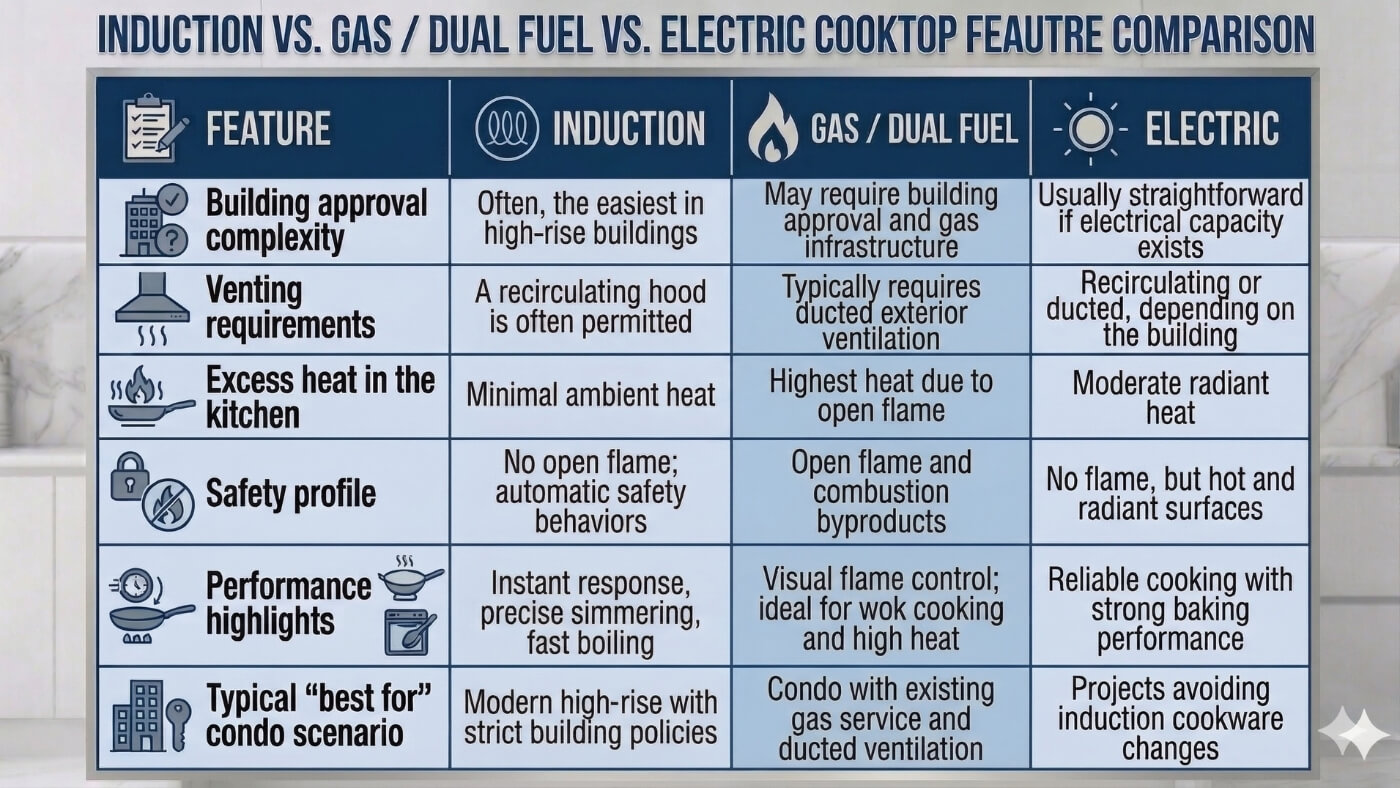
In a condo setting, choosing a range depends as much on building constraints as on cooking style. Induction, gas/dual fuel, and electric each carry different implications for ventilation, approval complexity, and day-to-day performance in a Miami high-rise environment.
Size and Fit in Condos: 30” vs 36” vs 48”
Range size affects more than appearance. Appliance width, cabinetry layout, electrical capacity, ventilation infrastructure, and installation logistics all influence which size is practical for a condo kitchen.
What Most Miami Condos Can Realistically Accommodate
In most condo kitchens, 30-inch and 36-inch ranges are the most common options.
A 30-inch range fits the majority of condo layouts and is often the default size in existing cabinetry configurations.
A 36-inch range offers additional cooktop space and oven capacity, making it a popular upgrade for open-plan kitchens designed for entertaining.
A 48-inch range, however, is typically reserved for large-format renovations or penthouse residences. These installations usually require expanded cabinetry, higher-capacity ventilation systems, and electrical or gas infrastructure that standard condo kitchens may not support.
Because of these requirements, larger ranges are generally planned as part of a full kitchen redesign rather than a direct replacement.
Additional Verifications
Before selecting a range size, several practical details should always be confirmed:
- Cabinet cutout dimensions and clearance requirements
- Door swing space within the kitchen layout
- Elevator and hallway access for appliance delivery
- Staging and installation planning within building guidelines
Addressing these logistics early helps prevent delays during appliance delivery and installation.
Installation, Venting, and Clearances
Range installation in a condo involves more than simply connecting power or gas. Ventilation infrastructure, clearance requirements, and building approvals can all influence the final appliance choice.
Venting Options: Ducted vs Recirculating
Two ventilation approaches are common in condo kitchens.
Ducted ventilation removes cooking air through ductwork that exhausts outside the building. This approach is typically required for gas cooking.
Recirculating ventilation filters air and returns it to the kitchen. Many condo buildings permit this for induction and electric ranges.
Before selecting a hood, confirm with building management:
- Whether exterior ducting is permitted
- Any ventilation capacity restrictions
- Requirements specific to gas appliances
Electrical / Gas Requirements
Each range category places different demands on building infrastructure.
- Induction ranges typically require a dedicated 240-volt circuit.
- Gas ranges require approved gas piping and confirmation that the building permits gas appliances.
Clarifying these requirements early helps prevent installation delays.
The Advantage of Partnering with Experts for Miami Condo Projects
Selecting a premium range is easier when you can compare cooking technologies and installation requirements with expert guidance.
Working with an authorized appliance dealer provides access to knowledgeable specialists who understand both the product lineup and the realities of condo installations.
Homeowners and design professionals can benefit from:
- Personalized appliance recommendations based on kitchen layout and building constraints
- Exclusive wholesale or trade pricing for qualified projects
- Live product demonstrations in a local showroom environment
- Coordinated delivery and installation planning that aligns with condo building policies and scheduling requirements
For Miami-area renovations, visiting a showroom allows homeowners to compare cooking technologies and control systems in person before making a final decision.
Recommended Picks by Condo Scenario
Different building conditions and cooking preferences naturally point toward different appliance choices.
Common condo scenarios include:
- Brickell high-rise with no gas service → Miele induction range
- Existing gas line with proper exterior ventilation → Miele gas or dual fuel range
- Older building with electrical limits → Miele electric range (or induction if a panel upgrade is feasible)
- Open-plan condo kitchen used for entertaining → 36-inch induction range
- Large penthouse renovation with full infrastructure support → 48-inch range configuration
Matching the appliance to both the building’s infrastructure and the homeowner’s cooking style usually leads to the most successful installation.
Choose with Confidence: The Right Miele Range for Your Building
Working with experienced appliance specialists can ensure the range you choose fits both your building requirements and your preferred cooking style, creating a kitchen that performs reliably for years to come.
If you’re planning a kitchen upgrade, request a quote with Drimmers and receive a personalized range recommendation along with a condo fit check.