



Cooking and baking in South Florida come with variables that most kitchen guides don't account for. Miami's climate is warm year-round, consistently humid, and unrelenting through summer—conditions that place quiet but measurable pressure on cooking performance. Dough behaves differently, crust formation becomes less predictable, and moisture balance inside the oven shifts in ways that cooking technique alone cannot fully correct.
For homeowners investing in kitchen appliances, these inconsistencies matter. Understanding how environmental humidity affects your cooking process is the first step toward choosing technology that accounts for it, and Miele's combi steam ovens are engineered to deliver the kind of control Miami kitchens need for consistent results.
Key Takeaways
- Miami's humid climate affects baking consistency, crust formation, and moisture balance in ways that standard ovens cannot compensate for.
- Steam ovens introduce precise, controlled moisture into the cooking environment regardless of outdoor conditions.
- Miele combi steam ovens combine convection heat with targeted humidity injection, delivering consistent results that conventional ovens cannot reliably match in South Florida kitchens.
How Miami's Humidity Affects Cooking and Baking
Humidity is water vapor suspended in the air, and in South Florida, there is a lot of it. Relative humidity in the Miami area frequently climbs above 80 percent during summer months, creating conditions that affect everything from how materials dry to how your ingredients behave and what your cooking requirements demand from your oven.
What Happens to Dough and Crusts in Humid Air?
Flour absorbs moisture from its surroundings. When ambient humidity is high, dough can take on more water than a recipe accounts for, altering its structure before it ever reaches the oven. The result is often a texture that feels slightly off—denser than expected, or less responsive to heat in the early stages of baking.
Crust formation presents a related challenge. A well-developed crust depends on the rapid evaporation of surface moisture when dough meets heat. In drier conditions, this process happens quickly and predictably. In humid air, surface moisture lingers longer, the evaporation window narrows, and achieving a clean, defined crust becomes less reliable.
Why Moisture Balance Becomes Harder to Predict
Beyond baking, humidity affects the broader moisture environment inside the oven cavity. Conventional ovens draw in ambient air during preheating, and on a humid Miami afternoon, that air carries significantly more water than it would in a drier climate. Because of this, the internal cooking environment shifts—only subtly, but enough to affect timing, texture, and finish in dishes where food quality and precision matter.
For a homeowner who has invested in a serious kitchen, these inconsistencies represent a gap between what the space is capable of and what the oven can reliably deliver. Addressing that gap requires more than technique—it requires technology that reliably controls moisture content on its own terms.
Why Traditional Ovens Struggle With Florida’s Humidity
Standard ovens are designed for controlled indoor environments where temperature and humidity remain relatively stable. In South Florida, those conditions rarely hold consistently, which can make the limitations of conventional ovens more noticeable — especially for people who cook frequently.
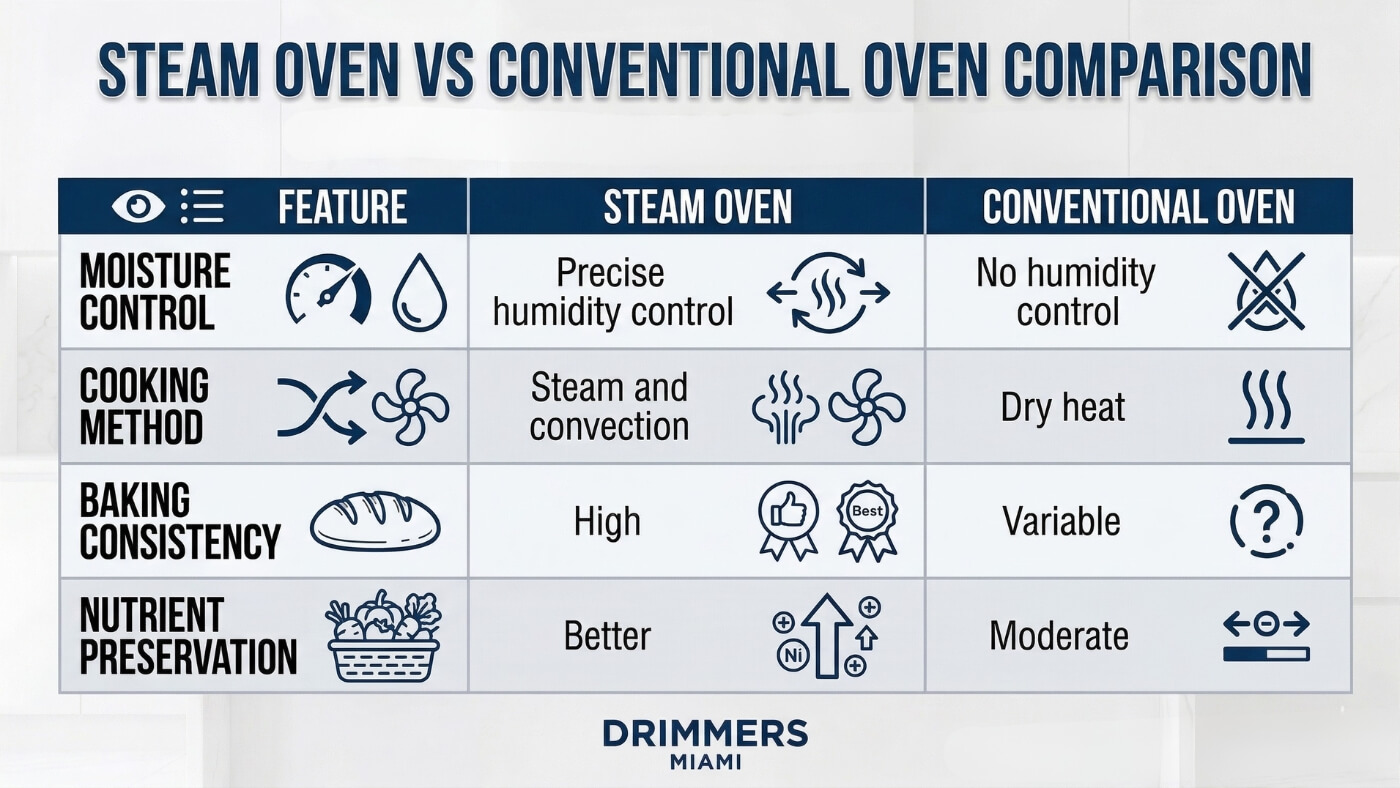
Traditional ovens rely on dry heat. A heating element warms the oven cavity, and in convection models, a fan circulates the air while moisture released during cooking escapes through passive vents. This system works well in stable environments but offers no way to actively control the oven's humidity.
In humid climates like Miami, that limitation can affect cooking consistency. Over time, home cooks may notice:
- Baking results that vary between seasons
- Roasting times that shift unexpectedly
- Less reliable visual and tactile cooking cues
- Previously reliable adjustments producing inconsistent outcomes
These challenges reflect a category limitation rather than a brand issue. Dry-heat ovens were simply not designed to actively manage humidity, which is why climate conditions can have a greater impact on cooking results in coastal environments like South Florida.
How Steam Ovens Control Moisture in Miami's Climate
A steam oven changes the equation by introducing moisture content on the cook's terms rather than the environment's. Instead of drawing in ambient air and accepting whatever humidity it carries, a steam oven generates its own moisture, which is calibrated precisely, introduced at the right moment, and fully independent of conditions outside.
This distinction matters more than it might initially appear. When you control the moisture inside the oven, you control one of the key variables that determine how food cooks. Steam can be introduced during the early stages of bread baking to keep the surface supple and allow the loaf to expand fully before the crust sets, and it can be reduced during the final phase to encourage browning and crispness.
For roasting, heat circulates evenly throughout the cavity, producing consistent results from edge to center. For fish, vegetables, or grains that benefit from retained moisture, a consistent cooking environment can be maintained throughout.
Miele Combi Steam Ovens and Precision Humidity Control
Miele combi steam ovens are engineered to manage temperature and humidity as independent variables, giving you control over both simultaneously rather than accepting whatever balance the environment provides.
In a South Florida kitchen, where that environment is rarely neutral, that independence is what separates consistent results from unpredictable ones. Their compact design integrates neatly into standard cabinet configurations, and the range of available functions gives your kitchen maximum flexibility across every style of cooking.
Several features define how Miele delivers that control in practice. Each addresses a specific aspect of cooking consistency that becomes more relevant in high-humidity climates.
- Combination Steam and Convection Cooking: Miele combi steam ovens combine steam injection with convection heat, allowing the oven to shift between moist and dry cooking environments within a single program. The combined functions support everything from delicate steaming to perfect roasting—a wider range of dishes than either method alone could achieve.
- Precise Humidity Injection: Humidity levels can be set and maintained independently of oven temperature—particularly valuable in climates where ambient moisture would otherwise unpredictably influence the cooking environment.
- Multi-Stage Cooking Programs: Guided programs automate temperature, humidity, and timing sequences for specific dishes. Easy to operate and designed to sit neatly within your cabinet configuration, they provide a reliable baseline that removes guesswork without limiting the experienced cook.
Why Miele Steam Ovens Work Especially Well in Miami Kitchens
South Florida’s climate changes how kitchens perform. Year-round heat, high ambient humidity, and a lifestyle built around entertaining place more pressure on cooking appliances than in many other parts of the country. In these conditions, the difference between a conventional oven and a well-engineered steam oven becomes much more noticeable.
Miele combi steam ovens address that challenge by precisely controlling the oven’s internal moisture and temperature. Dishes that depend on careful humidity balance, like bread, pastry, roasted meats, and delicate fish, cook more consistently because the oven regulates its environment rather than reacting to the day’s weather. In Miami kitchens, that level of control turns a traditionally unpredictable variable into a reliable cooking advantage.
Visit our Miami showroom to experience Miele's steam oven range firsthand and discover how precision cooking performs in your kitchen.
FAQs About Miele Steam Ovens
1. Can a Miele steam oven replace a regular oven?
In most kitchens, yes. Miele combi steam ovens handle the full range of everyday cooking tasks while offering precise humidity control that a conventional oven cannot. For kitchens where space allows only one oven, a Miele combi steam oven is a capable and versatile replacement.
2. Do Miele steam ovens require a water connection?
Miele steam ovens are available with either a direct water connection or a refillable reservoir, depending on the model and installation. Built-in models designed for luxury kitchens typically include a plumbed connection for added convenience, while reservoir models offer flexibility where plumbing access is limited.