









When choosing appliance manufacturers for your Miami kitchen, the choice rarely comes down to a single factor. Miele and Bosch both have strong reputations for premium dishwashers that clean thoroughly, run quietly, and blend seamlessly into open-plan kitchens and modern layouts. Where they diverge is in engineering depth, automation, and longevity, and these are differences that become more noticeable over time.
Understanding how these brands compare across cleaning performance, noise levels, technology, and durability will help you choose your next dishwasher and find the one that best fits your kitchen.
Key Takeaways
- Both Miele and Bosch are known for quiet, effective cleaning. The key differences come down to their engineering priorities and long-term design approach.
- Miele dishwashers are designed and tested for up to 20 years of regular use, with automation features like AutoDos that reduce daily effort and improve long-term consistency.
- For luxury kitchens where longevity and precision are the priority, Miele represents the deeper long-term investment.
Miele and Bosch Dishwashers at a Glance
The differences between these Bosch and Miele appliances are sharpest when placed side by side. Noise levels, lifespan, drying technology, automation, and rack design all tell a more complete story together than any single spec can on its own.
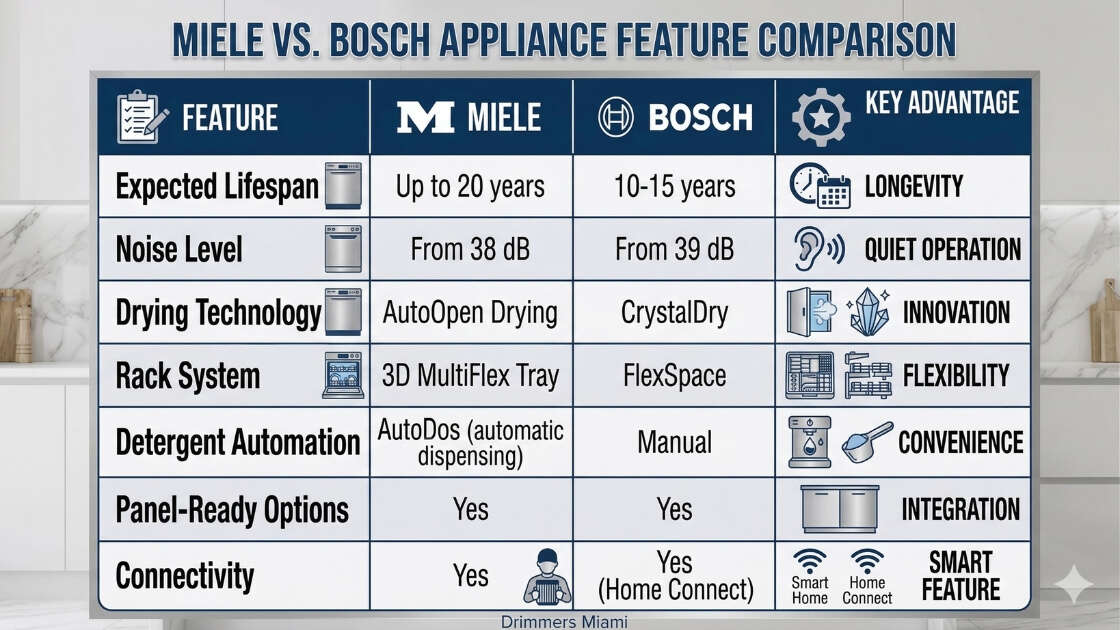
Noise levels are comparable across both brands at this tier, and panel-ready integration is available from each. The more meaningful gaps appear in lifespan, automation, and drying approach, which are areas where the two brands have made distinctly different engineering choices.
Energy Efficiency, Cleaning Performance, and Wash Technology
Cleaning performance is largely a baseline expectation rather than a major differentiator. Both Miele and Bosch optimize water pressure, spray coverage, and filtration to handle everything from heavily soiled cookware to delicate glassware. In everyday use, either brand delivers consistently strong results.
Modern dishwashers balance cleaning power with efficiency. Sensors, spray systems, and filtration technology allow the appliance to adjust water usage, pressure, and cycle time based on soil levels, helping maintain strong results while keeping energy and water consumption low. Many ENERGY STAR–certified dishwashers use only a few gallons of water per cycle.
Bosch
Bosch dishwashers focus on practical efficiency and flexible loading.
Key features include:
- Adjustable rack systems for different dish and cookware sizes
- Sensor-driven wash programs that adapt to load conditions
- Efficient water and energy use designed for everyday performance
Miele
Miele dishwashers emphasize wash precision and long-term consistency. Their systems maintain full spray coverage while minimizing water consumption.
- Optimized spray arm layout for even cleaning coverage
- Advanced filtration systems that keep water clear during cycles
- Eco programs use about 6–8 liters of water per cycle
- Optional hot-water connections that can reduce energy demand
Miele’s approach reflects a broader philosophy: appliances designed to deliver consistent cleaning performance throughout many years of use.
Which Dishwasher is Quieter?
Quiet operation has become one of the defining criteria in premium dishwasher selection—particularly in open-plan Miami homes and condos where kitchens flow directly into living and entertaining spaces. A dishwasher running during dinner or while guests are in the next room is no longer an acceptable trade-off at this price point.
Both Miele and Bosch manufacture some of the quietest dishwashers available, and at this tier, the differences rely in degrees rather than leaps. Premium models from each brand operate between 38 and 44 decibels—a level essentially imperceptible during normal conversation—and, in everyday use, neither brand has a meaningful edge over the other.
Where they begin to separate is in how that performance holds up over time:
- Miele engineers its motor design and insulation for longevity, with quiet operation maintained as a sustained standard rather than an early-ownership feature.
- Bosch achieves comparable results in its top-tier models, with noise levels that compete closely at the premium end of its range.
If near-silent operation is a non-negotiable for your kitchen, both brands can deliver. Still, for buyers who expect that standard to hold for a decade, Miele's approach to motor design and insulation is worth understanding before you decide.
Technology and Smart Features
Modern premium dishwashers have moved well beyond basic wash cycles, and both Miele and Bosch have invested heavily in features that reduce daily effort and improve results over time.
Miele's technology centers on automation and precision:
- AutoDos automatically measures and dispenses the correct amount of detergent for each load, removing one of the most common variables in cleaning consistency.
- AutoOpen drying releases the door at the end of the cycle, allowing steam to escape and improving how dishes dry naturally.
- Smart connectivity enables remote monitoring and programme selection from your phone.
Bosch models focus on drying performance and flexible integration:
- CrystalDry uses a naturally occurring mineral called zeolite to convert moisture into heat, reducing reliance on a traditional heating element while delivering exceptionally dry results—particularly on plastics.
- Home Connect adds full remote control and monitoring via smartphone, keeping the appliance integrated into a connected home.
- FlexSpace racks offer versatile load configurations that adapt easily to different dish types and sizes.
Miele's automation runs deeper, reducing the daily decisions that most owners don't realise they're making until they no longer have to.
Durability and Lifespan
Lifespan is one of the most practical factors to weigh when investing in a luxury Miami kitchen. While both manufacturers have strong reputations for reliability, their engineering philosophies approach longevity in somewhat different ways.
Miele: Built for Long-Term Use
Miele designs and tests its dishwashers to withstand the equivalent of 20 years of regular household use. In practical terms, that means thousands of wash cycles conducted under testing conditions intended to simulate real daily demands.
This extended lifespan reflects several core design priorities:
- High-quality internal components built to tolerate repeated thermal and mechanical stress
- Robust mechanical and electronic systems engineered for long-term stability
- An overall engineering philosophy focused on longevity rather than typical appliance replacement cycles
For homeowners who expect their appliances to remain in place for decades, this long-term durability can be a significant advantage.
Bosch: Strong Reliability Within a Typical Lifespan
Most premium dishwashers typically deliver a 10 to 15-year lifespan under normal household conditions.
Within that window, Bosch has a well-earned reputation for dependable performance and consistent cleaning results. For many buyers, that level of durability represents excellent long-term value and aligns with the expected lifespan of many modern kitchen appliances.
Why the Difference Matters in a Luxury Kitchen
For homeowners designing a long-term Miami kitchen they intend to live in for decades, the difference between a 10–15-year appliance and a 20-year appliance can become significant.
Replacing a dishwasher in a luxury kitchen is rarely a simple swap. Because many premium kitchens use integrated designs and custom panels, a mid-cycle replacement can introduce additional complexity, such as:
- Matching or replacing custom cabinetry panels
- Coordinating with existing cabinetry dimensions and finishes
- Scheduling installation within a completed kitchen environment
Planning for longevity from the outset can help reduce the likelihood of these disruptions later, especially in kitchens designed as long-term living spaces rather than short-term upgrades.
Luxury Design Elements to Look for in a New Dishwasher
A dishwasher in a luxury kitchen needs to earn its place visually as much as it does functionally. In modern Miami homes and condos, where the kitchen is visible from every angle, seamless integration is an expectation rather than an added detail. When shopping for a high-end dishwasher, look for these design elements:
- Fully Integrated Design: Appliances that sit flush with cabinetry, hiding controls behind the door for a clean, uninterrupted look.
- Panel-Ready Options: Custom panels that match your cabinetry allow the dishwasher to blend in completely, maintaining pristine sightlines.
- Premium Brand Support: Both Miele and Bosch offer panel-ready and fully integrated options across their top-tier ranges, ensuring consistency in quality and aesthetics.
- Minimalist Hardware: Subtle handles or handleless designs keep the focus on the kitchen design, not the appliance.
- Flexible Placement: Consider dishwashers that can be installed in varied locations while still maintaining the luxury design flow, ideal for open-concept layouts.
Panel-ready dishwashers have become the standard in luxury renovations precisely for these reasons, giving homeowners a seamless, elegant kitchen experience without compromising performance.
Why a Miele Dishwasher is Worth the Investment
Evaluating a new dishwasher on upfront cost alone misses the more important calculation. The relevant consideration is what the appliance delivers over the ten, fifteen, or twenty years it operates in your kitchen before a replacement is even required.
Miele becomes the stronger investment when these factors define your kitchen:
- Longevity: A 20-year design standard that outlasts most premium competitors by nearly a decade.
- Automation: AutoDos and AutoOpen reduce daily friction and maintain consistent results without manual input.
- Engineering Precision: Components and systems built to perform at the same level in year fifteen as they do on day one.
- Long-Term Value: A higher upfront cost that becomes considerably more measured when spread across two decades of uninterrupted performance.
For homeowners designing a kitchen that reflects the same standard of quality in every detail, that depth of engineering is precisely what the investment delivers.
Ready to Explore Miele Dishwashers at Drimmers? Experience the precision, quiet performance, and durability that make Miele dishwashers a favorite in luxury kitchens. Visit our Miami showroom to see them in action.
Frequently Asked Questions About Miele Dishwashers
1. Are Miele dishwashers worth the higher price?
For many homeowners, the higher upfront cost of a Miele dishwasher reflects its long-term engineering and durability. Miele designs many of its appliances to operate for up to 20 years of regular use, which is significantly longer than the lifespan of most dishwashers. For buyers focused on long-term ownership rather than short-term savings, the investment can make practical sense.
2. What is a panel-ready dishwasher?
A panel-ready dishwasher accepts a custom cabinet panel on its front. This design allows the dishwasher to visually blend into the surrounding cabinetry, making it appear almost invisible within the kitchen layout. Panel-ready appliances are common in luxury kitchens and open-concept homes where maintaining clean lines and a cohesive design is important. Both Miele and Bosch offer panel-ready dishwasher models that integrate seamlessly with custom cabinetry.